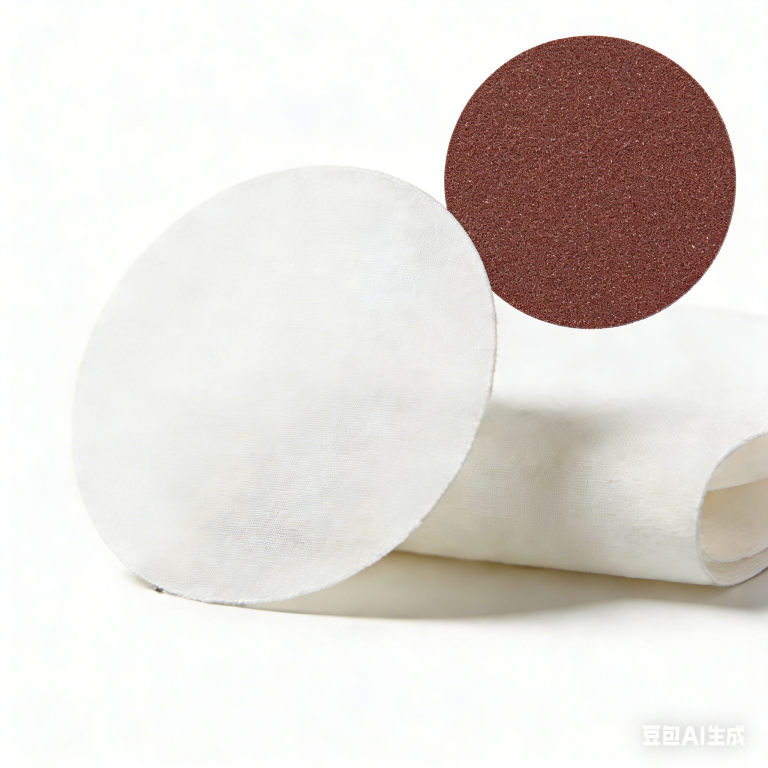
In decoration, furniture making, hardware processing and 3C product grinding, hook and loop for abrasive combined with sandpaper is a key consumable to boost efficiency. As the core substrate for holding sandpaper and ensuring grinding stability, the performance of hook and loop for abrasive fabrics directly determines grinding precision, consumable lifespan and operational safety. Choosing the right hook and loop for abrasive fabrics enables the composite sandpaper to fit different grinding needs, avoiding issues like peeling and substrate scratching. This article details the scientific selection method of hook and loop for abrasive from four dimensions: material selection, structural design, adhesion compatibility and industry customization.
1.Fabric Material:nylon&polyester
Nylon and polyester are the two most widely used core materials for hook and loop for abrasive fabrics. Both have distinct strengths. You must match them to core grinding needs.
nylon
Nylon excels in flexibility and adaptability. It also has good water absorption and moisture resistance. Thus, it performs well in close-fitting or wet grinding scenarios.
For example, wall grinding targets uneven putty or cement surfaces. Nylon’s high flexibility lets composite sandpaper cling tightly, ensuring even grinding with no dead spots.
Wall grinding often uses wet methods to reduce dust. Its moisture resistance prevents softening or deformation when wet. Add a waterproof coating, and you further extend its service life.
Besides, nylon has excellent fatigue resistance. It resists breakage after repeated bending. So it suits manual grinding tasks that need frequent angle adjustments, like precision finishing of furniture edges and corners.
polyester
Polyester fabric boasts high strength, toughness and excellent heat resistance. So it is ideal for heavy-load, high-speed grinding.
Its tear resistance far exceeds nylon. The warp tensile strength reaches over 400N/5cm. It withstands heavy cutting forces in hardware processing, such as metal derusting and weld finishing, and prevents sandpaper detachment due to fabric damage.Meanwhile, it resists temperatures above 120℃. In high-speed furniture grinding (wood and paint surfaces), it avoids shrinkage or deformation from friction heat, maintains flatness, ensures even polishing and prevents defects like orange peel.Besides, it has strong dimensional stability. It won’t shrink after cutting. Thus, polyester fabric suits batch customization into standard shapes (discs, rolls), fits automated tools (wall sanders, hardware belt grinders) and boosts work efficiency.
2.Fabric Structure
Warp density, thickness and surface treatment decide sandpaper stability and adaptability.
First, use loose-weave fabric for rough grinding (wall leveling, weld cleaning). It boosts cutting force and clears dust.
Then, choose dense-weave fabric for fine grinding (furniture/3C polishing). It ensures even sanding and smooth finishes.
For heavy grinding, pick thick canvas. It resists sander centrifugal force. For light manual work, use thin flexible fabric for easy handling.
3.Adhesion Compatibility
Bond strength stops sandpaper from falling off. Focus on fabric adhesion and surface treatment.
- First, for mechanical grinding, pretreat fabrics with corona or glue. Use epoxy adhesive—it resists 120℃+ heat and shear.
- Then, for manual grinding, pick hot-melt-adhesive fabrics. They are cheap and suit light work.
- Finally, when grinding wet, use waterproof coated fabrics. They stop adhesive from failing and fabric from softening.
4.Industry Customization
Furniture Industry
Its grinding mostly involves wood and paint surfaces. You need to balance fineness and adhesion, so choose 80-120g nylon hook and loop for abrasive. It fits curved and flat grinding scenarios, avoiding base material scratches and ensuring uniform grinding.
Decoration Industry
Its grinding includes rough grinding of wall putty and stone. Choose 150-200g polyester hook and loop for abrasive. It is wear-resistant and tear-resistant, fits large-area rapid grinding, and improves construction efficiency.
Hardware Industry
Its grinding targets metal derusting and deburring. Choose 120-200g nylon or polyester blend hook and loop for abrasive. It has strong adhesion and resists high-speed grinding, fitting the fine grinding needs of hardware edges and corners.
3C Industry
Its grinding focuses on 3C product precision plastic and metal parts. Choose 60-80g ultra-thin nylon hook and loop for abrasive. It is flexible, fits tiny curved surfaces accurately, and ensures grinding precision and surface finish.
Conclusion
To choose hook and loop for abrasive, focus on fabric performance first. Then check material compatibility, structural rationality, adhesion stability and industry customization needs.
Only if you match the fabric with sandpaper, grinding materials and working conditions accurately, can you maximize the sandpaper’s benefits, boost efficiency, improve quality and balance costs and effects optimally.