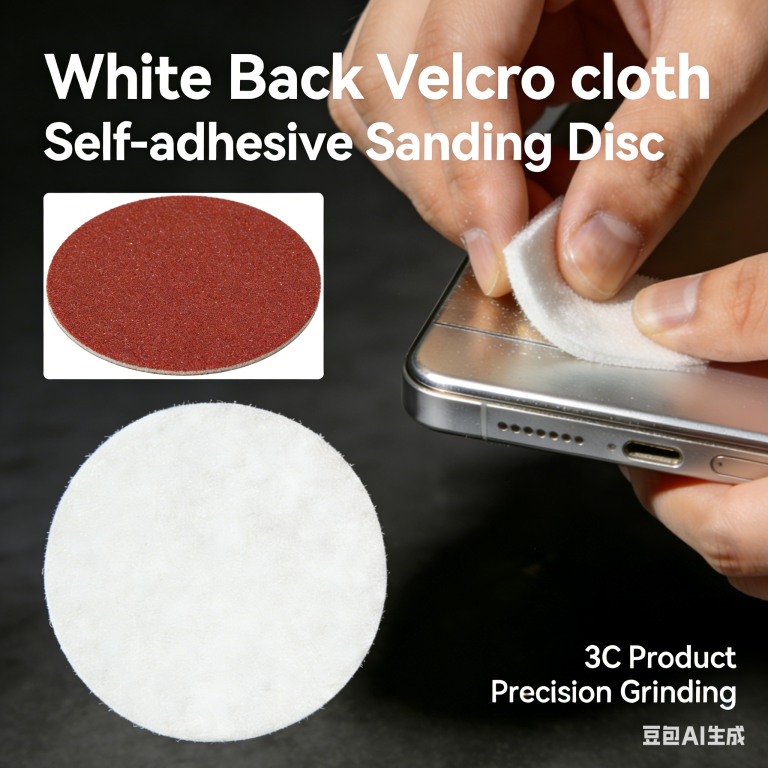
Velcro sanding discs are widely used in woodworking, automotive refinishing, metalworking, and surface finishing.
They are easy to install and remove. However, some sanding discs lose adhesion during use. The disc may move, become loose, or separate from the backing pad.
Many manufacturers check the hook material or adhesive first. However, the Velcro backing fabric can also affect the final performance.
What Causes Adhesion Problems?
Several factors can reduce the adhesion of a Velcro sanding disc.
Uneven Pile Density
The pile surface should be uniform.
If the pile density varies, the hooks may not engage evenly. This can lead to lower adhesion, poor stability, and shorter service life.
Therefore, abrasive converters should pay close attention to pile consistency.
Incorrect Pile Height
Pile height also affects hook engagement.
If the pile is too short, the hooks may not engage properly. If it is too long or loose, stability may decrease in some applications.
Therefore, the pile structure should match the hook material and final application.
Insufficient Fabric Strength
Sanding creates continuous friction, vibration, and tension.
High-speed sanding puts even more stress on the backing fabric.
If the fabric is not strong enough, its structure may become damaged. As a result, the hook-and-loop connection can become weaker.
Does Higher GSM Mean Better Performance?
Not necessarily.
GSM is only one factor when selecting Velcro backing fabric.
For example, 120 GSM is not automatically better than 75 GSM. The right choice depends on the sanding application, disc construction, hook material, and required flexibility.
In general:
- 55–75 GSM: lightweight and flexible applications
- 90–120 GSM: more demanding applications
- 120+ GSM: heavy-duty applications
- High-strength fabric: applications requiring higher durability
Therefore, choose the right fabric structure instead of simply choosing the highest GSM.
Polyester or Nylon?
Nylon is known for its softness and good hook engagement.
Polyester can provide good strength, dimensional stability, and cost efficiency.
However, the choice should not simply be based on material type.
For abrasive applications, specially engineered polyester yarns can provide adhesion performance close to nylon. At the same time, polyester can offer a significant cost advantage.
Therefore, compare:
- Adhesion
- Strength
- Flexibility
- Abrasion resistance
- Dimensional stability
- Cost
The right polyester fabric can provide a good balance between performance and cost.
Why Is Fabric Consistency Important?
For abrasive converters, one good sample is not enough.
The fabric should remain stable from roll to roll and from batch to batch.
Important factors include:
- GSM consistency
- Uniform pile density
- Stable pile height
- Fabric strength
- Width consistency
- Surface uniformity
Consistent fabric helps manufacturers maintain stable production and finished-product quality.
Why Should You Test Samples?
Photos cannot show the actual performance of Velcro backing fabric.
Lighting and camera angles can also affect the appearance of the pile.
Therefore, always test samples for:
- Adhesion strength
- Hook engagement
- Fabric strength
- Abrasion resistance
- Repeated attachment and removal
Testing under actual working conditions gives a more reliable result than simply comparing photos or specifications.
Choose the Right Fabric for Your Application
There is no single Velcro backing fabric that fits every abrasive product.
For general sanding discs, 55 GSM and 75 GSM can be suitable choices when you need a lightweight backing.
For more demanding applications, higher GSM or high-strength Velcro backing fabric may be a better option.
At the same time, thinner fabric is not necessarily easier to produce. Lightweight fabric requires precise production control to maintain a uniform and stable pile structure.
Conclusion
Velcro backing fabric plays an important role in sanding disc performance.
When a sanding disc loses adhesion, do not look only at the hook material or adhesive. Check the entire hook-and-loop system.
Pay attention to pile density, pile height, GSM, fabric strength, abrasion resistance, and batch consistency.
At Abrasive Velcro Cloth, we manufacture polyester and nylon Velcro backing fabrics for sanding discs, polishing pads, and other abrasive applications.
We offer different GSM options and high-strength fabric for demanding applications.
Contact us for technical specifications and samples.