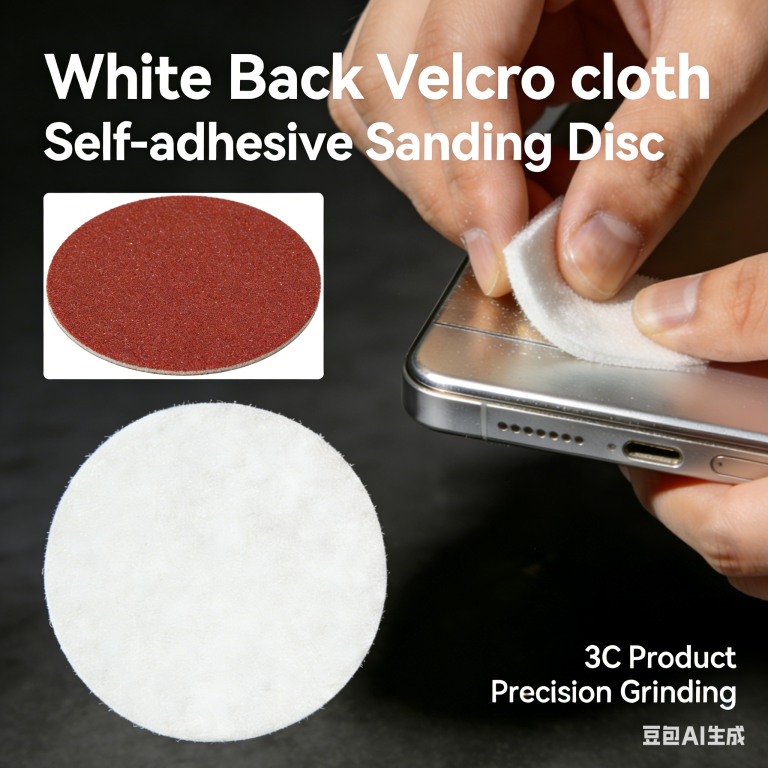
Velcro sanding discs are widely used for wood sanding, automotive repair, metalworking, and surface preparation.
They are easy to attach and remove. They also make sanding faster and more convenient.
But one problem can affect sanding performance:
The sanding disc loses adhesion during use.
Why does this happen?
The problem does not always come from the Velcro system itself. The backing fabric, hook structure, heat, pressure, and sanding conditions can all affect adhesion.
In this article, we will look at the main reasons why Velcro sanding discs lose adhesion and how to choose the right backing fabric.
1. Weak Hook and Loop Adhesion
The first possible reason is weak hook and loop adhesion.
A Velcro sanding disc needs a strong connection between the hooks and loops. If the loops are too weak, too short, or not suitable for abrasive applications, the sanding disc may not stay firmly attached.
This can become more serious during high-speed sanding.
A good abrasive backing fabric should provide:
- Strong hook engagement
- Uniform loop structure
- Stable adhesion
- Good resistance to repeated attachment and removal
The backing fabric plays an important role in the performance of the whole sanding disc.
2. The Backing Fabric Is Too Soft or Too Weak
Backing fabric needs to balance flexibility and strength.
If the fabric is too soft, it may deform during sanding.
If it is too weak, the loop structure may wear quickly.
This can reduce the contact area between the hook and loop system.
For sanding applications, the fabric should have a stable structure while still providing enough flexibility for the application.
This is especially important for sanding discs used on curved surfaces.
3. Excessive Heat During Sanding
Heat is another important factor.
High-speed sanding can generate significant heat between the abrasive disc and the workpiece.
Excessive heat may affect the backing material and the bonding system.
If the backing fabric cannot maintain its structure under higher temperatures, adhesion may become weaker.
This is one reason why material selection matters.
Polyester backing fabric can be a good choice for applications that require better heat resistance and dimensional stability.
4. Poor Fabric Structure
The structure of the backing fabric directly affects hook engagement.
A uniform and dense loop surface can provide more consistent contact with the hooks.
If the surface structure is uneven, the hook engagement may become inconsistent.
This can lead to:
- Reduced adhesion
- Uneven sanding
- Disc movement
- Premature disc detachment
For abrasive applications, fabric consistency is therefore very important.
5. The Wrong Fabric Weight
GSM is another factor to consider.
Different sanding applications may require different fabric weights.
A lightweight fabric can offer good flexibility and help reduce material consumption.
A heavier fabric can provide greater support and stability.
There is no single GSM that is best for every sanding application.
The right choice depends on:
- Abrasive grit
- Disc size
- Sanding speed
- Application surface
- Required flexibility
- Required adhesion
For example, lighter backing fabrics can be suitable for some sanding disc applications, while higher-weight fabrics may be preferred when greater support is required.
6. Frequent Attachment and Removal
Velcro sanding discs are often attached and removed many times.
This is one of the main advantages of the hook and loop system.
However, repeated use also creates mechanical stress on the loops.
If the loop structure has poor wear resistance, adhesion can gradually decrease.
A high-quality abrasive backing fabric should maintain its loop structure after repeated use.
This helps provide more stable performance throughout the product’s service life.
7. The Abrasive Application Is Too Aggressive
The sanding conditions also matter.
High pressure, high speed, coarse grit, and continuous sanding can create greater mechanical stress.
For aggressive sanding applications, the backing fabric needs sufficient:
- Tensile strength
- Wear resistance
- Dimensional stability
- Hook and loop adhesion
Choosing a backing fabric only by price can create problems later.
The fabric should be selected according to the actual sanding conditions.
How Can You Prevent Adhesion Problems?
Choosing the right abrasive backing fabric is one of the most important steps.
Before purchasing, consider the following factors:
1. Adhesion
Make sure the fabric provides strong and stable hook engagement.
2. Wear Resistance
The loop structure should withstand repeated use.
3. Heat Resistance
For high-speed sanding, choose a material that can maintain stable performance under heat.
4. Dimensional Stability
The fabric should not easily deform during production or sanding.
5. Flexibility
The backing fabric should match the application and sanding surface.
6. Consistent Quality
GSM, width, surface structure, and physical properties should remain consistent from roll to roll.
Nylon or Polyester: Which Is Better?
Both nylon and polyester can be used for abrasive backing fabric.
Nylon is known for its softness, flexibility, and strong hook and loop adhesion.
Polyester offers good heat resistance, dimensional stability, and cost efficiency.
The best material depends on the application.
For example, nylon can be suitable when flexibility and strong adhesion are the main priorities.
Polyester can be a good option when stability, heat resistance, and cost control are important.
The key is not simply choosing nylon or polyester.
The key is choosing a fabric that is designed specifically for abrasive applications.
What Makes Abrasive-Grade Velcro Backing Fabric Different?
Not all Velcro fabric is designed for sanding applications.
Abrasive products create different requirements.
The backing fabric needs to work with:
- High-speed sanding
- Repeated attachment and removal
- Abrasion
- Heat
- Mechanical pressure
- Different abrasive grits
For this reason, the yarn, knitting structure, fabric weight, and finishing process all matter.
Using yarn and fabric structures developed specifically for abrasive applications can help improve the performance of the final sanding disc.
Conclusion
When a Velcro sanding disc loses adhesion, the problem may come from more than one factor.
The main causes include:
- Weak hook and loop adhesion
- Poor fabric structure
- Low wear resistance
- Excessive heat
- Fabric deformation
- Incorrect fabric weight
- Aggressive sanding conditions
The backing fabric is an important part of the sanding disc.
Choosing the right Velcro backing fabric for abrasive applications can help improve adhesion, stability, durability, and overall sanding performance.