Velour backing fabric may look simple.
However, it plays an important role in hook and loop abrasive products.
The loop surface must connect well with the hook pad. It also needs to stay stable during production and use.
Poor fabric quality can cause problems during converting. As a result, it may also affect the final sanding disc.
So, what problems should abrasive manufacturers watch for?
Here are five common issues.
1. Uneven Pile Surface
First, let’s look at the pile surface.
A good velour fabric should have a uniform and dense pile.
An uneven surface can lead to different levels of hook engagement. Some areas may have strong adhesion, while others may have weak adhesion.
As a result, the finished sanding disc may not perform in the same way across the whole surface.
For abrasive applications, look for:
- Uniform pile
- Good loop density
- Stable pile height
- Smooth surface
- Consistent structure
Good surface quality helps create a more stable hook and loop connection.
2. Weak Hook and Loop Adhesion
Next, let’s talk about adhesion.
A hook and loop sanding disc needs a secure connection with the backing pad.
Poor engagement may cause the disc to move during sanding. In some cases, the disc may even come off during use.
However, the hook material is not always the cause.
The loop fabric can also affect adhesion. Yarn type, pile density and finishing can all change the final result.
For this reason, manufacturers should test the complete hook and loop system.
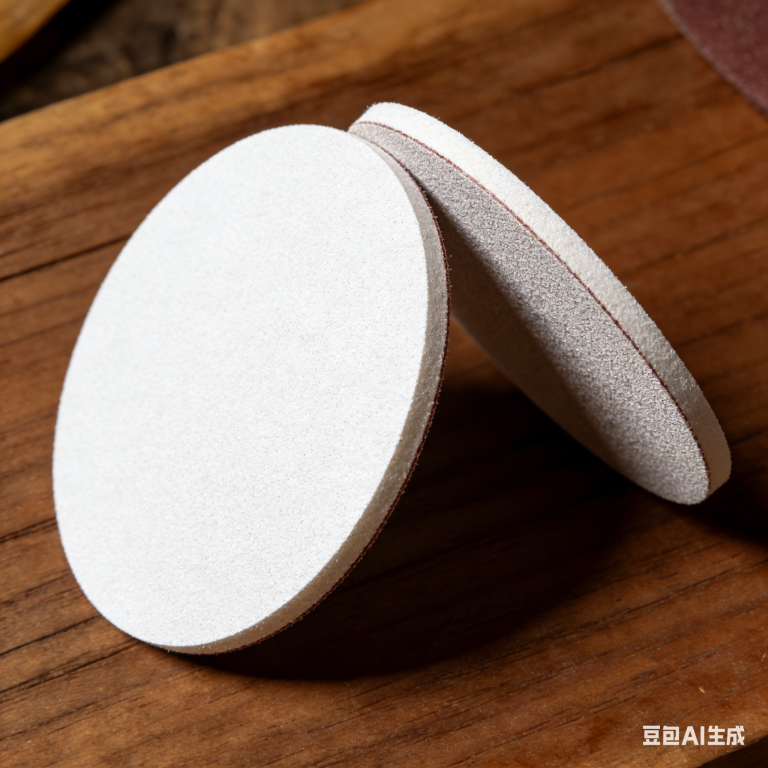
Commercial velour-backed abrasive discs use a loop surface on the back of the disc. This surface connects with the hook backing pad and allows users to change discs quickly.
3. Fabric Deformation During Production
Fabric deformation is another common problem.
During production, abrasive manufacturers may laminate, coat, slit or cut the fabric.
Poor fabric stability can cause several problems, such as:
- Wrinkles
- Uneven edges
- Difficult cutting
- Size changes
- Poor disc shape
Good dimensional stability makes the converting process easier.
In addition, stable fabric can help manufacturers keep the final product more consistent.
Therefore, test the fabric during your actual production process.
4. Different Quality Between Batches
Batch variation can create another challenge.
For example, your first order may work well. The next order may feel different.
GSM may change from one batch to another. Pile density may also change.
Surface quality can vary as well.
Even small changes may affect production. They can also change the performance of the finished sanding disc.
For abrasive manufacturers, consistent quality matters.
A reliable supplier should control:
- Fabric weight
- Fabric width
- Yarn
- Pile construction
- Surface density
- Finishing process
With stable production, manufacturers can reduce quality problems.
More importantly, they can keep the performance of their finished products more consistent.
5. Choosing Fabric Only by Price
Price is important when buying raw materials.
However, it should not be the only factor.
Two fabrics may have a similar price per kilogram, but their performance can be very different.
One fabric may offer better pile density and better stability. Another may cost less but cause more problems during production.
Therefore, compare more than price.
Consider these factors:
- Hook and loop adhesion
- Pile uniformity
- Fabric strength
- Dimensional stability
- Wear resistance
- Converting performance
- Batch consistency
In the long run, stable quality may save more money than a small difference in material price.
How Can You Avoid These Problems?
Most of these problems can be reduced by choosing the right fabric and supplier.
First, define your application.
Ask yourself:
- What type of abrasive product do you make?
- What GSM do you use?
- What width do you need?
- Do you use polyester or nylon?
- What converting process do you use?
- What problems do you have with your current fabric?
Once these points are clear, you can choose a more suitable fabric.
Choose the Right Material
Both polyester and nylon can work well for abrasive applications.
Nylon offers good flexibility and strong hook engagement.
By comparison, polyester offers good strength, stability and cost efficiency.
Still, fiber type is not the only factor.
Yarn selection also matters. So do knitting structure, pile construction and finishing.
For abrasive applications, specially developed polyester yarns can provide strong hook and loop adhesion while keeping the cost advantage of polyester.
Check the Pile Carefully
Pile quality also deserves close attention.
A good velour fabric should have a dense and even surface.
When checking a sample, look for:
- Even pile
- Good loop density
- No obvious thin areas
- Stable surface structure
- Consistent appearance
Also, check the fabric across the full width.
Do not judge the material from one small area only.
A full-width check can give you a better idea of the real fabric quality.
Test the Fabric in Your Own Production
Before placing a large order, run a sample test.
Use the same:
- Abrasive material
- Adhesive
- Production process
- Hook backing pad
- Sanding conditions
Then compare the results.
This approach gives you a clear view of the fabric performance.
More importantly, it lets you compare suppliers under the same conditions.
Why Choose an Experienced Velour Fabric Manufacturer?
Velour backing fabric is a special textile product.
Several production steps can affect its final performance.
A typical process may include:
Warp Knitting → Pile Formation → Finishing → Heat Setting → Inspection → Rolling
Each step needs good process control.
For example, yarn selection affects the fabric structure. Knitting affects the pile. Finishing affects the surface and stability.
Therefore, production experience matters.
Our Velour Backing Fabric for Abrasive Applications
At Haining Jinyang Knitting Co., Ltd., we specialize in velour backing fabric for abrasive applications.
With more than 30 years of production experience, we understand the needs of abrasive manufacturers.
Both polyester and nylon velour fabrics are available.
Our polyester yarns are specially developed for grinding applications.
As a result, our polyester velour fabric can provide strong hook and loop adhesion while keeping the cost advantage of polyester.
Different GSM and width options are also available.
Our fabric can be used for:
- Hook and loop sanding discs
- Sanding pads
- Sponge sanding pads
- Polishing pads
- Automotive polishing products
- Industrial abrasive products
Customized specifications can also be discussed based on your production needs.
Test Our Velour Backing Fabric
Are you using another velour supplier now?
You do not need to change suppliers immediately.
Instead, test our fabric first.
Run both materials under the same production conditions.
Then compare:
Adhesion → Pile → Strength → Stability → Converting → Final Product
This simple test can help you make a clear comparison.
It can also show whether our fabric fits your production process.
Looking for a Reliable Velour Backing Fabric Supplier?
If you produce hook and loop sanding discs or other abrasive products, we can help.
Simply send us your:
Material + GSM + Width + Application
Based on your needs, our team can recommend a suitable velour backing fabric.
We can also provide samples for testing.
Contact us today to request samples and technical information.