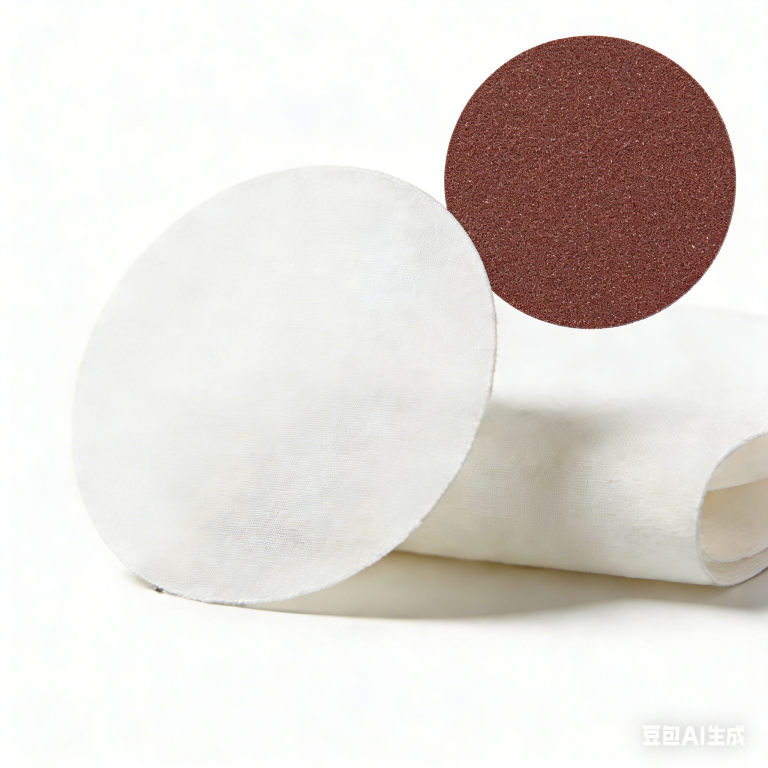
When choosing velour backing fabric for hook & loop sanding discs, many buyers first look at GSM, material, width, and price.
However, they may miss another important factor: pile density.
Two velour fabrics may have the same GSM. They may also look similar. However, they can perform very differently on sanding discs.
Pile density is one reason for this difference.
A dense and even pile can help the hooks grip the fabric better. As a result, the sanding disc can stay more stable during use.
So, why is pile density so important
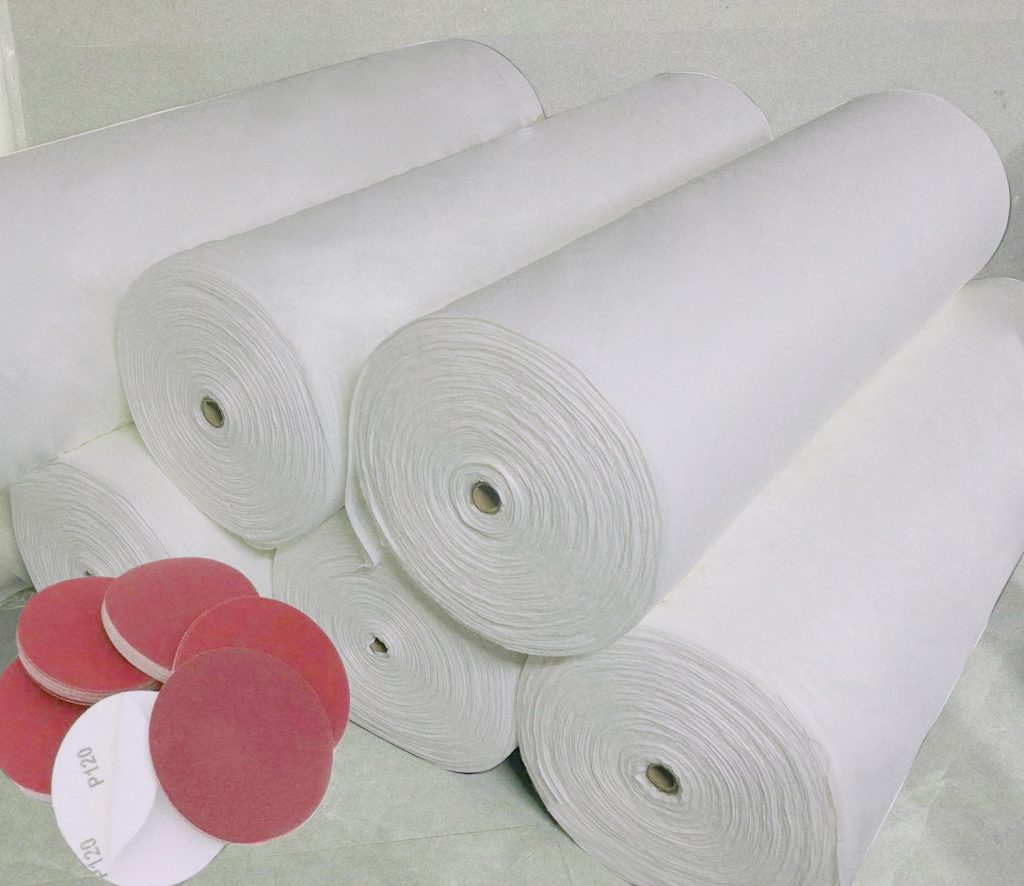
What Is Velour Pile Density?
Velour backing fabric has many small loops on its surface. These loops connect with the hooks on the backing pad.
Pile density means how closely these loops cover the fabric surface.
Good velour backing fabric usually has:
- Dense pile
- Even pile
- Stable pile height
- A clean and uniform surface
If the pile is too thin or uneven, the hooks have fewer places to grip.
As a result, the holding strength may become weaker.
How Does Dense Pile Improve Hook and Loop Adhesion?
A hook and loop system has two main parts: the hook side and the velour loop side.
When you press a sanding disc onto a backing pad, the hooks enter the loops of the velour fabric.
Therefore, the number and quality of the loops can affect the grip.
A dense pile gives the hooks more points to connect with.
This can bring several benefits.
More Even Contact
A dense pile helps the hooks connect with the fabric across a larger area.
Therefore, the sanding disc can attach more evenly to the backing pad.
Stable Holding Strength
Good hook engagement helps keep the sanding disc in place during sanding.
This is especially important when the sanding machine runs at high speed.
More Stable Quality
Abrasive manufacturers need stable materials.
If the pile density changes from one area to another, the grip may also change.
Therefore, an even pile helps manufacturers keep the quality of their sanding discs more stable.
What Happens If the Pile Is Too Sparse?
A sparse pile does not always mean the sanding disc will fail.
However, it can reduce the contact between the hooks and the velour loops.
For example, the sanding disc may not attach evenly to the backing pad.
This may cause:
- Weak grip
- Uneven attachment
- Disc movement during sanding
- Less stable performance at high speed
- Early separation from the backing pad
In some demanding applications, poor hook and loop contact may even increase the risk of the disc coming off during sanding.
Therefore, abrasive manufacturers should not only check the GSM. They should also check the actual pile structure.
Why Is an Even Pile Important?
Pile density is important. However, pile uniformity is also important.
For example, one part of the fabric may have a dense pile, while another part may have a thin pile.
The average GSM can still meet the required standard. However, the hook and loop performance may not be the same across the whole fabric.
Therefore, good velour backing fabric should have both a dense pile and an even pile.
This helps the sanding disc get a more stable grip across its full surface.
Same GSM Does Not Mean the Same Quality
Many buyers compare velour backing fabrics mainly by GSM.
However, GSM only tells us the weight of one square meter of fabric.
For example, Supplier A and Supplier B may both offer 115 GSM velour fabric.
Does this mean the two fabrics have the same quality?
No.
Many other factors can affect the final performance, such as:
- Yarn quality
- Knitting structure
- Pile density
- Pile height
- Raising process
- Heat setting
- Fabric strength
- Hook and loop grip
Therefore, two 115 GSM fabrics can have very different pile surfaces and holding strength.
This is also why buyers should not choose velour backing fabric only by GSM and price.
The actual fabric quality is more important.
Why Does Pile Density Matter for Heavy-Duty Sanding?
Heavy-duty sanding puts more stress on the sanding disc.
For example, metal sanding often needs higher speed and stronger sanding force.
Therefore, the sanding disc needs a stable connection with the backing pad.
A dense and even pile can help create better contact between the velour and the hooks.
As a result, the sanding disc can stay more stable during use.
However, pile density is not the only factor.
The final performance also depends on:
- Hook type
- Backing pad condition
- Sanding speed
- Working pressure
- Abrasive material
- Disc structure
- Lamination quality
Therefore, manufacturers should test the velour fabric with their own hook system before mass production.
How Do We Create a Dense and Even Pile?
Good pile quality starts during production.
Several production steps can affect the final velour surface.
1. Yarn Selection
Good yarn helps us produce a stable fabric structure.
Therefore, we carefully select yarn for abrasive backing applications.
2. Warp Knitting
The knitting process forms the base of the fabric.
We control the knitting process to keep the fabric structure and GSM stable.
3. Raising
Raising is one of the most important steps.
During this process, we create the soft velour surface.
We control the raising process to keep the pile short, dense, and even.
4. Heat Setting
Heat setting helps keep the fabric stable.
It also helps control the width and shape of the finished fabric.
5. Quality Inspection
Finally, we check the finished fabric.
We pay attention to GSM, width, pile surface, and overall quality.
At Haining Jinyang Knitting Co., Ltd., we focus on producing velour backing fabric with a dense and uniform pile for abrasive applications.
How Can You Check Velour Backing Fabric?
When you receive a new sample, do not only read the specification sheet.
First, look at the fabric surface.
Check whether the pile is dense and even.
Then, touch the fabric and compare different areas.
You can also compare samples from different suppliers side by side.
Most importantly, test the fabric with your own hook system.
You can check:
- GSM
- Pile density
- Pile uniformity
- Pile height
- Fabric strength
- Hook and loop grip
- Repeated attachment
- Stability during sanding
Different hooks may work differently with the same velour fabric.
Therefore, actual testing is always important.
Conclusion
For hook & loop sanding discs, velour backing fabric does more than cover the back of the abrasive.
It also helps connect the sanding disc to the backing pad.
Therefore, the pile structure can directly affect the grip.
A dense and even pile gives the hooks more points to connect with. As a result, it can help improve holding strength and sanding stability.
However, buyers should not judge velour backing fabric only by GSM.
The same GSM does not always mean the same quality.
Yarn, knitting structure, pile density, pile height, raising, heat setting, and fabric strength can all affect the final performance.
We produce polyester and nylon velour backing fabric for abrasive applications.
We offer different GSM and width options for sanding discs, sponge abrasives, polishing products, and other hook & loop abrasive products.
If you are looking for a new velour backing fabric or want to compare it with your current material, contact us for samples.
You can test our fabric with your own hook system before placing a bulk order.